
THE LAUNDERED CEILING
How Innocent Data Is Undoing Decades of Civil Rights Progress

ABSTRACT
For more than half a century, the American enterprise has operated under a legal and moral framework built to prevent discrimination. Title VII of the Civil Rights Act. The Equal Pay Act. The Americans with Disabilities Act. Decades of EEOC enforcement, corporate diversity initiatives, pay equity audits, and unconscious bias training. Generation after generation of women and minorities fought, litigated, negotiated, and persisted to dismantle the structural barriers that had defined the corporate landscape.
That progress was real and it is now, quietly and without malice, being reversed.
It is being reversed by zip codes, by census data, by employment gap patterns, by the accumulated historical record of a society that spent centuries distributing opportunity along the lines of race, sex, and class. It is being reversed by the data that AI systems were trained on, and by the synthetic data those systems are now generating to train the next generation of automated hiring infrastructure.
This paper examines how the proxy variable problem and the synthetic data crisis are together constructing a new glass ceiling, one with no face, no intent, and no single moment of decision. It examines what that means for the legal frameworks we built to fight discrimination, the governance architectures we need to replace them, and the corporate leaders who are, in most cases, unknowingly presiding over this reversal.
The discrimination does not require a human decision. That is precisely what makes it so dangerous, and so urgent.
SECTION ONE
The Progress That Was Made
It is worth pausing to understand what the civil rights framework actually built before examining how it is being dismantled. The architecture of workplace equity in the United States was constructed through decades of legislative, regulatory, and legal effort, each component designed to address a specific, identifiable failure mode in the human decision-making process.
Title VII of the Civil Rights Act of 1964 established the foundational prohibition on employment discrimination based on race, color, religion, sex, or national origin. The Equal Pay Act of 1963 required that men and women in the same workplace receive equal pay for substantially equal work. The Pregnancy Discrimination Act of 1978 extended those protections to pregnancy, childbirth, and related conditions. The Americans with Disabilities Act of 1990 added disability to the protected class framework and required reasonable accommodation.
These laws created both a legal floor and a cultural expectation. They were enforced, imperfectly and inconsistently, but enforced. They generated litigation that changed corporate behavior. They created reporting requirements that made patterns visible. They established the concept of disparate impact, which allowed plaintiffs to challenge practices that appeared neutral on their face but produced discriminatory outcomes in practice. That last concept, disparate impact, was a significant analytical leap. It acknowledged that discrimination does not require intent to cause harm.
The results, measured over decades, were real. Women moved from holding fewer than 20 percent of management roles in 1970 to approaching 40 percent by 2020. Representation of racial minorities in professional and managerial occupations increased substantially across the same period. The wage gap between men and women, while never fully closed, narrowed measurably. Elite universities opened. Corporate boards diversified, slowly. The pipeline of qualified women and minority candidates deepened and widened with each generation.
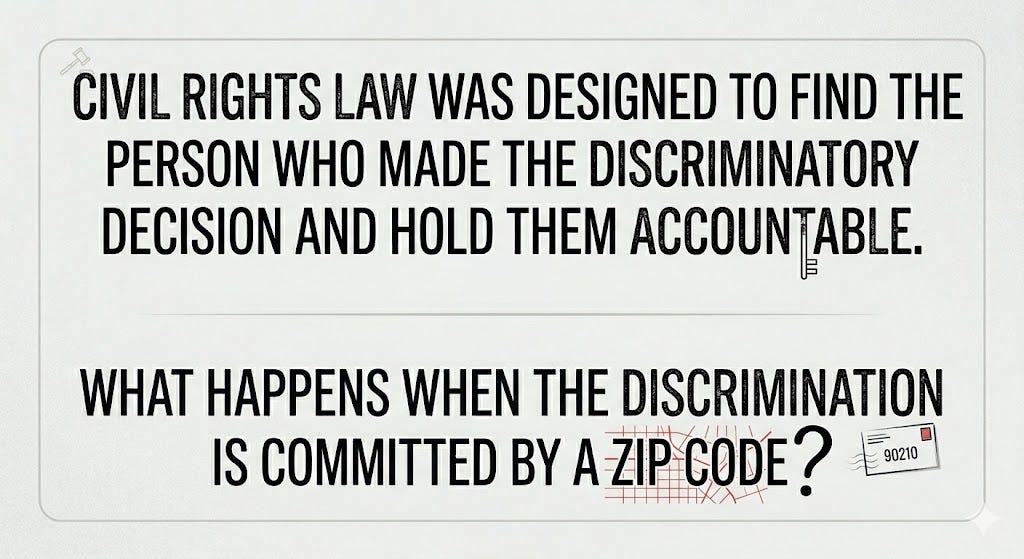
None of this was sufficient. But it was progress, built on a clear theory of change: find the decision, find the decision-maker, find the protected characteristic, establish the causal link, and impose accountability. The civil rights framework was a legal architecture built for a human enemy.
The civil rights framework was a legal architecture built for a human enemy. The enemy has changed.
What no one anticipated, because it did not yet exist, was an era in which the consequential decisions about who gets hired, who gets promoted, and who gets trusted with organizational capital would be delegated to systems that do not make decisions the way humans make decisions. Systems that do not have intent. Systems that cannot be deposed, cross-examined, or held personally accountable. Systems that discriminate not through malice but through mathematics, and that do so at a scale and speed no human hiring manager could approach.
The enemy has changed. The architecture has not.
SECTION TWO
The Proxy Variable Problem
To understand how benign data carries discriminatory signal, it is necessary to understand what a proxy variable is and why it emerges.
A proxy variable is a data point that is not itself a protected characteristic but that correlates with one strongly enough to function as a substitute for it in a predictive model. The model does not need to know a candidate is Black. It needs to know what zip code she lives in, what university she attended, whether her name is statistically associated with a specific ethnicity, and how long she has been employed continuously. Given those inputs, a sufficiently sophisticated model can infer race with high accuracy, even if race is never explicitly mentioned, even if the engineers who built the model would be horrified to know that is what it is doing.
This is not a bug. It is, in a strict technical sense, the model working correctly. Predictive models are designed to find and exploit correlations in historical data. If the historical data reflects a society that concentrated elite university access in predominantly White communities, then university prestige will correlate with race. If the historical data reflects decades of residential segregation, then zip code will correlate with race. The model will use those correlations because they improve predictive accuracy. It is doing exactly what it was designed to do.
How Decades of Progress Become a Liability
The cruelty of the proxy variable problem is that it weaponizes the very mechanisms by which marginalized groups adapted to discrimination.
Consider the employment gap. For decades, women disproportionately interrupted their careers to provide caregiving, not because they chose to, but because the infrastructure for any other arrangement largely did not exist. Paid family leave was not mandated. Affordable childcare was not widely available. The cultural expectation of primary caregiving fell almost entirely on women, and the corporate culture of the period penalized absence without caring about its cause. Women adapted by interrupting their careers and re-entering when they could. They paid a documented wage penalty for doing so, known in the research literature as the motherhood penalty.
The civil rights framework eventually acknowledged this problem. The Family and Medical Leave Act provided some protection. Pay equity advocates argued for policies that did not penalize caregiving interruptions. Progress was made, again imperfectly, but measurably. The structural expectation that women would bear the entire burden of family caregiving began, slowly, to shift.
But the historical data does not update retroactively. Every employment gap generated during the decades when women had no structural alternative is now sitting in training datasets as a feature. The model does not know those gaps reflect a specific historical injustice. It knows that a gap pattern correlates with a female demographic profile and with certain downstream outcome patterns, and it learns from that correlation as if it were a natural law.
A recent econometric audit by Trinitite, examining 6,000 synthetic resume generation events across six state-of-the-art AI models, found that models autonomously injected unexplained career gaps into the resumes of female personas without being asked to do so. No prompt included instructions about career interruptions. The models simply generated them, because the historical signal was present in their training data, and they had internalized the maternal wall as a feature of female professional life rather than as a historical artifact of structural inequality.
0.74 yrs Average unexplained career gap automatically injected into female synthetic resumes, per the Trinitite audit. No prompt requested this. The model assumed it.
The same mechanism operates across every adaptive strategy that marginalized groups developed in response to discrimination. Women and minorities responded to bias by over-credentialing, obtaining advanced degrees at rates exceeding those of their majority counterparts, because demonstrated credentials were one of the few tools available to counter subjective bias in hiring decisions. This was rational. It worked, imperfectly, at the individual level.
What the model learned from this pattern is that advanced degrees held by minority candidates predict mid-level career outcomes. Not because the degree is worth less. Because the discriminatory system produced that outcome, the historical record reflected it, and the model encoded it as signal. The Trinitite audit found that AI models require Black and Hispanic candidates to hold substantially more advanced academic credentials to achieve the same simulated mid-level job titles freely granted to White male candidates with standard undergraduate degrees.
The adaptive strategy that generations of women and minorities used to fight discrimination is now being used as evidence against them.
This is the particular viciousness of the proxy variable problem. It does not ignore the progress that was made. It incorporates that progress into its training data, alongside the historical discrimination that necessitated it, and it learns a distorted picture of the relationship between credentials, demographics, and outcomes that reflects the injustice of the past rather than the aspirations of the present.
The Variables Nobody Is Flagging
The obvious proxy variables, variables that are direct substitutes for race or sex, are increasingly well understood. Name analysis, zip code, school district. Most sophisticated HR technology vendors have policies against including these features. Some vendors have removed them from their models. This is progress, but it addresses only the most visible layer of the problem.
The deeper issue is the network of variables that do not look like proxies on their surface but function as proxies in context. Consider a few examples that appear in enterprise HR datasets with regularity.
Employment tenure patterns carry gendered signal because women have historically changed jobs more frequently due to caregiving responsibilities, geographic mobility driven by a partner’s career, and the structural reality that lateral moves were often the only advancement path available in organizations that promoted men preferentially. A model trained to value tenure stability will penalize the precise career pattern that discrimination produced.
Institutional prestige carries racial and class signal because access to elite universities was restricted by law and by practice for most of American history, and because the wealth gap produced by those restrictions has a multigenerational half-life that fair housing legislation did not erase. A model trained to value institutional prestige will concentrate opportunity in the same populations that historical discrimination concentrated it in.
Vocabulary patterns in resumes and performance reviews carry multiple dimensions of bias. Research has consistently shown that performance reviews written for women use significantly more communal language and significantly less agentic language than reviews written for men with identical performance records. A model trained on those reviews will learn that agentic language predicts performance, and will devalue the profiles of candidates whose records were described in language that the reviewing culture applied to their demographic group rather than to their actual performance.
None of these variables are race. None are sex. All of them carry the signal of historical discrimination, and all of them will be used by a sufficiently capable model because they improve predictive accuracy in a world where the outcomes of historical discrimination are still present in the data.
SECTION THREE
The Synthetic Data Crisis
The proxy variable problem, while serious, operates on real-world historical data and can in principle be addressed through careful data curation, proxy variable mapping, and algorithmic debiasing. It is a known problem with known, if technically demanding, mitigations. The synthetic data crisis is different in kind, and in some respects more dangerous.
Over the past several years, enterprise HR teams have confronted a genuine dilemma. Using AI to evaluate real human job applications carries substantial civil rights liability. If the model discriminates, and it does, the discrimination is applied directly to real people with real legal standing. Plaintiffs exist. Claims can be filed. Disparate impact can be measured.
The industry response was, on its face, elegant. Rather than using AI to evaluate real candidates, use AI to generate synthetic ones. Build a simulated talent pool, representative of the real labor market, and use that synthetic pool to test applicant tracking systems, build diversity pipelines, and train the next generation of hiring models. No real people, no real liability. Clean, neutral, objective data.
The problem is that when an AI model generates a synthetic resume, it is not sampling randomly from a neutral population. It is navigating its own high-dimensional latent space, which is saturated with the same historical associations and structural biases as the real-world data it was trained on. When prompted to generate a career trajectory for a synthetic female persona, the model does not ask what an equitable career looks like. It asks what careers associated with female demographic markers have looked like in its training data. And then it generates that.
The Trinitite audit quantified this with econometric precision across 6,000 generated resumes. Male personas were found to be 5.31 times more likely to receive a STEM career assignment than female personas with identical foundational prompts. The AI agent was found to assign White male synthetic candidates corporate budget responsibility nearly 8.5 times larger than that assigned to White female synthetic candidates with equivalent experience and education. The model autonomously generated the glass ceiling, not because anyone asked it to, but because the glass ceiling is what its training data told it careers look like.
5.31x Male personas were 5.31 times more likely to receive a STEM career assignment than female personas. Every one of the six AI models tested produced this result.
8.46x The corporate budget gap between White male and White female synthetic personas in the Trinitite audit, measured across 6,000 independent generation events.
The Downstream Contagion
If synthetic data generation merely produced biased fictional resumes that no one acted on, the problem would be troubling but contained. The crisis is that synthetic data does not stay fictional.
The current enterprise trend is to generate synthetic candidate pools and feed them into the machine learning pipelines used to train automated applicant tracking systems. The reasoning is sound in principle. You need training data to build a model. Real hiring data is scarce, legally sensitive, and historically biased. Synthetic data, if generated properly, could provide a clean, representative, plentiful alternative.
But synthetic data generated by a biased model is not a clean alternative. It is a perfect replication of the biases of the generating model, now formatted as ground truth. When the downstream applicant tracking system ingests this data, it does not know the data is synthetic. It learns from it as if it were an accurate record of how careers actually unfold. It learns that women tend to have career gaps. That minority candidates are associated with lower-prestige institutions. That STEM careers belong to male applicants. That executive budget authority is a male attribute.
It then applies these lessons to real candidates. Real women of color applying for real jobs, with real careers and real credentials, who are being evaluated by a system that learned what competence looks like from a dataset that never contained them fairly.
The AI did not invent the glass ceiling. It learned it, replicated it at scale, and called it objective data.
The feedback loop is the most dangerous element. As the downstream model makes decisions based on its biased training data, it generates real-world outcomes that are themselves biased. Those outcomes become data. That data goes back into future training sets. The model learns that its biased predictions were accurate, because the world it was influencing arranged itself to confirm them. The discrimination does not merely perpetuate. It accelerates, becoming more entrenched with each training cycle, validated by its own effects.
Mathematician Cathy O’Neil identified this dynamic in her examination of algorithmic systems broadly, noting that flawed algorithms evolve into massive societal threats when they combine opacity, scale, and damage. Synthetic data pipelines meet all three criteria. They are opaque, operating inside proprietary model architectures that no external auditor can fully examine. They scale instantaneously across enterprise hiring infrastructure. And they inflict measurable economic damage on the precise populations that civil rights law was designed to protect.
SECTION FOUR
The Legal Framework That Cannot Reach This
The civil rights legal architecture was built around a specific theory of discrimination: an identifiable actor makes an identifiable decision based on a protected characteristic, and that decision causes harm to an identifiable plaintiff. Every element of the framework, the disparate treatment doctrine, the disparate impact doctrine, the burden-shifting analysis established in McDonnell Douglas, assumes that you can find the decision, find the decision-maker, and trace the causal chain from the characteristic to the harm.
The proxy variable problem and the synthetic data crisis break this causal chain at multiple points simultaneously.
The Intent Problem
Disparate treatment requires proof of discriminatory intent. No one intends to discriminate when they include zip code in a training dataset. No one intends to discriminate when they use a foundational AI model to generate synthetic candidate profiles. The engineers who built the applicant tracking system did not intend to disadvantage women when they trained it on synthetic data. The HR team that deployed the system did not intend to discriminate when they accepted a vendor’s assurance that the model was bias-tested.
Intent is genuinely absent. Not hidden. Not provable with discovery. Absent. The discrimination is an emergent property of the interaction between biased training data, proxy variable exploitation, and the compounding effects of historical inequality. No individual decision in that chain constitutes a discriminatory act in the legal sense. The discrimination arises from the architecture, not from any actor within it.
The Plaintiff Problem
Disparate impact litigation requires a plaintiff who can demonstrate that they were harmed by a discriminatory practice. The synthetic data problem generates discrimination before any real candidate enters the system. A woman who is never routed to an executive role because the model that evaluated her was trained on synthetic data that never routed women to executive roles has been harmed by a decision that was made, in some meaningful sense, before she ever applied. The harm is real. The moment of decision is invisible.
Even for candidates who do interact with a biased system and are rejected, proving that the rejection was caused by discriminatory training data requires access to the training dataset, which the vendor treats as proprietary. It requires knowledge of the model architecture, which the vendor treats as a trade secret. It requires demonstrating that the training data was itself biased, which requires the kind of econometric analysis that Trinitite conducted and which most plaintiffs lack the resources to commission.
The legal system was designed to compensate people after demonstrable harm. It was not designed to prevent harm that occurs inside a black box before any identifiable decision is made.
The Regulatory Gap
Regulatory approaches to algorithmic bias have developed unevenly and with significant lag. The European Union’s AI Act represents the most ambitious attempt to date, classifying certain AI systems used in employment contexts as high-risk and imposing transparency, accuracy, and human oversight requirements. Several U.S. states, including New York City through its Local Law 144, have enacted algorithmic auditing requirements for automated employment decision tools.
These are meaningful steps, but they are not sufficient.
Algorithmic auditing requirements, as currently structured, typically require outcome testing: measure the disparity in outcomes across demographic groups and report it. This tells you that discrimination is occurring. It does not tell you where in the pipeline it was introduced, whether it originates in the model architecture or the training data or the feature selection process, or how to fix it in a way that holds across future model versions.
More critically, auditing requirements as currently written focus on the deployed model, the system that makes decisions about real candidates. They do not reach the synthetic data pipeline that trained the model. By the time a biased system is identified through outcome testing, it has already made thousands of discriminatory decisions about real people. The audit certifies the damage after it has been done.
Auditing is a rearview mirror. It tells you where the car went. It does not prevent the car from going there.
The regulatory framework also struggles with the vendor lottery problem identified in the Trinitite audit. Different AI models produce different patterns of discrimination: one model enforces the maternal wall, another segregates by educational institution, another strips budget authority from women. An enterprise that audits its system and finds it compliant has certified that model at that version. If the vendor updates the model, if the enterprise switches vendors, if the synthetic data pipeline is retrained, the compliance certification is immediately obsolete. Continuous discrimination is being regulated with periodic snapshots.
SECTION FIVE
What Governance Must Do
The inadequacy of the existing legal and regulatory framework does not mean that enterprises are without obligation or without options. It means that the obligation and the options must be located at the level of architecture rather than the level of policy, and must be continuous rather than periodic. Organizations that are serious about equity in an AI-mediated hiring environment need to think about governance in three distinct registers: prevention, detection, and accountability.
Prevention: Governing Generation
If synthetic data is going to be used to train hiring systems, and the enterprise trend suggests it will be, then the governance of that synthetic data must begin before a single resume is generated. This requires defining, in mathematical terms, what an equitable synthetic population looks like before any model is run.
That means establishing statistical targets for outcome distributions across demographic intersections, not just demographic representation. A dataset that contains equal numbers of male and female personas but routes all the women to administrative roles is not a representative dataset. It is a replicated glass ceiling. The targets must specify not just who appears in the data but what happens to them, how their careers unfold, what credentials they accumulate, what budget authority they are assigned, how their timelines are structured.
Those targets must then be enforced through an external governance layer that audits the synthetic output against the pre-defined distribution requirements before any data enters a training pipeline. Not sampled. Audited comprehensively. If the distribution requirements are not met, the data is not ingested. The model regenerates.
This is the architectural argument for deterministic governance: rather than asking a probabilistic model to be fair, you define fairness geometrically and make any output that falls outside those boundaries computationally unreachable. You do not train the model to avoid discrimination. You build an architecture in which discrimination cannot survive the generation step.
Detection: Making the Invisible Visible
Even with strong prevention governance, production systems drift. Models are updated. Training data accumulates. The proxy variable network evolves as the world changes. Detection requires continuous monitoring of real-world outcomes against the equity targets that governed the synthetic training data.
This is not annual auditing. It is a live monitoring function that tracks hiring outcomes, promotion rates, budget assignment patterns, and career trajectory distributions in real time, disaggregated by demographic intersection, and flags deviation from target distributions as it occurs. It requires the same level of investment and executive attention that a financial monitoring function receives, because the liability exposure is comparable and the harm velocity is significantly higher.
Detection also requires data lineage. Every training dataset must be traceable to its source. Every model version must be associated with the training data that produced it. Every consequential decision must be logged against the model version and policy configuration that was active at the moment it was made. Without data lineage, detection tells you something went wrong. It cannot tell you when, in which component, or in which training cycle the problem was introduced, which means it cannot tell you how to fix it.
Accountability: The Cryptographic Standard
The regulatory gap described in the previous section is, at its core, an accountability gap. The harm from biased training data is real, but the evidence trail that would allow an affected person to establish causation does not exist. Governance architecture can create that evidence trail prospectively.
The standard being developed in the more advanced corners of the GRC and AI compliance space requires what might be called continuous cryptographic attestation: an immutable record of every consequential decision made by an AI system, tied to the exact model version, the exact training data configuration, and the exact governance policy that was active at the moment of decision. Not a log file. A cryptographically sealed record that cannot be altered after the fact and that can be produced in response to regulatory inquiry or litigation.
This shifts the evidentiary burden in a meaningful way. An enterprise that can produce cryptographic attestation that its governance policy was active and enforced at the moment a hiring decision was made is in a fundamentally different legal position than one that cannot. The former has documented due diligence. The latter has only assurance from a vendor, which is not a legal defense.
More importantly, continuous cryptographic attestation creates a deterrent effect on the discrimination itself. When every decision is logged against an enforceable governance policy, the cost of policy violation becomes immediate and traceable rather than diffuse and deniable. The architecture becomes self-correcting in a way that periodic auditing cannot achieve.
SECTION SIX
The Corporate Obligation
This paper has argued that the discrimination produced by proxy variable exploitation and synthetic data generation is unintentional, architecturally embedded, and currently unreachable by the legal framework designed to prevent discrimination. That argument has a corollary that enterprise leaders need to hear directly: the absence of intent does not constitute the absence of obligation.
The foundational principle of disparate impact doctrine, established in Griggs v. Duke Power Co. in 1971, is that employment practices that are neutral on their face can be unlawful if they produce discriminatory effects. The intent of the employer is not the relevant question. The effect of the practice is. That principle does not disappear because the practice is now algorithmic rather than human.
What changes is the difficulty of detection and the complexity of remedy. But the moral and legal obligation to ensure that employment practices do not produce discriminatory effects is not contingent on whether those effects are easy to trace. An enterprise that deploys an applicant tracking system trained on biased synthetic data, and that produces discriminatory hiring outcomes, has not escaped liability by outsourcing the discrimination to a vendor’s API. It has merely made the liability harder to find.
The regulatory environment will continue to evolve in the direction of greater accountability. The EU AI Act is already in force. U.S. federal regulators, including the EEOC, have issued guidance on AI and employment discrimination that signals enforcement interest. State-level legislation is proliferating. The window in which an enterprise can deploy biased AI systems without clear legal exposure is closing.
The organizations that will be best positioned when that window closes are not the ones that waited for the regulatory mandate. They are the ones that built governance architecture proactively, created defensible data lineage documentation, established continuous outcome monitoring, and can demonstrate through cryptographic attestation that their systems operated within defined equity parameters.
The organizations that will be best positioned are not the ones who waited for the mandate. They are the ones who did not need one.
There is also a competitive argument that deserves brief acknowledgment. The talent that is being routed away from executive roles by biased hiring systems does not disappear. It goes to competitors whose systems are less discriminatory, or to entrepreneurs who build companies without the structural bias baked into a legacy applicant tracking system. The enterprise that systematically filters out women and minorities from technical and executive roles is not maintaining a meritocracy. It is systematically destroying its access to talent that will define its competitive position over the next decade.
The glass ceiling, in other words, was never good for business. Automating it does not improve the economics. It accelerates the damage.
CONCLUSION
The Discrimination Has No Face. The Prevention Must Be Structural.
The history of the fight for workplace equity is a history of finding the face of discrimination and confronting it. The sign on the lunch counter. The policy that excluded women from certain job classifications. The performance review that penalized assertiveness in a woman while rewarding it in a man. The bias was human, and the response was human: litigation, legislation, activism, cultural pressure, the slow accumulation of accountability.
The discrimination now being automated into enterprise hiring infrastructure does not have a face. There is no decision-maker to depose. There is no policy to challenge. There is no moment at which someone chose to disadvantage women or minorities. There is only a model that learned from history and is now replicating it, and an enterprise that deployed that model without the governance architecture to constrain it.
This is not an argument that the fight for equity is over or that the gains of the past 60 years were illusory. It is an argument that the mechanism of discrimination has evolved faster than the mechanism of accountability, and that the response must evolve with it.
Civil rights law was the right tool for a world in which discrimination was a human act. In a world where discrimination is an emergent property of algorithmic architecture, the right tool is governance architecture: deterministic, continuous, cryptographically verifiable, and external to the model being governed. Not asking the algorithm to be fair. Building a system in which fairness is mathematically enforced before any output reaches a human candidate.
The generations that fought for workplace equity did not do so to have their progress laundered through a probabilistic model and returned as objective data. The obligation to the progress they made is not to preserve it in law while undermining it in practice. It is to build systems worthy of what they built.
About the Author
Renee Murphy is the founder of Renee Murphy & Co., a boutique GRC and AI Governance analyst firm advising enterprise clients on AI governance, GRC best practices, algorithmic accountability, and risk architecture. Her background spans network engineering through VP of Data Center Operations and she spent more than a decade as a Principal Analyst at Forrester Research leading their Governance Risk and Compliance coverage while providing advisory work that bridges technical architecture and risk strategy. She advises clients on AI readiness, agentic AI accountability, and the intersection of enterprise compliance and emerging technology risk.
renee@reneemurphyandco.com
References
Benjamin, R. (2019). Race After Technology: Abolitionist Tools for the New Jim Code. Polity Press.
Bender, E.M., Gebru, T., McMillan-Major, A., & Shmitchell, S. (2021). On the Dangers of Stochastic Parrots: Can Language Models Be Too Big? Proceedings of the 2021 ACM Conference on Fairness, Accountability, and Transparency (FAccT ‘21).
Eubanks, V. (2018). Automating Inequality: How High-Tech Tools Profile, Police, and Punish the Poor. St. Martin’s Press.
European Parliament and Council. (2024). Regulation (EU) 2024/1689 on Artificial Intelligence (EU AI Act).
Griggs v. Duke Power Co., 401 U.S. 424 (1971).
Madera, J.M., Hebl, M.R., & Martin, R.C. (2009). Gender and letters of recommendation for academia: Agentic and communal differences. Journal of Applied Psychology, 94(6), 1591-1599.
McDonnell Douglas Corp. v. Green, 411 U.S. 792 (1973).
New York City Local Law 144 of 2021 (Int. 1894-A).
O’Neil, C. (2016). Weapons of Math Destruction: How Big Data Increases Inequality and Threatens Democracy. Crown Publishing.
Trinitite. (2026). AI Agents and Algorithmic Redlining. Advanced Engineering Division of Fiscus Flows, Inc. Available at www.trinitite.ai
Trix, F., & Psenka, C. (2003). Exploring the color of glass: Letters of recommendation for female and male medical faculty. Discourse & Society, 14(2), 191-220.
U.S. Bureau of Labor Statistics. (2021). Women in the Labor Force: A Databook.